


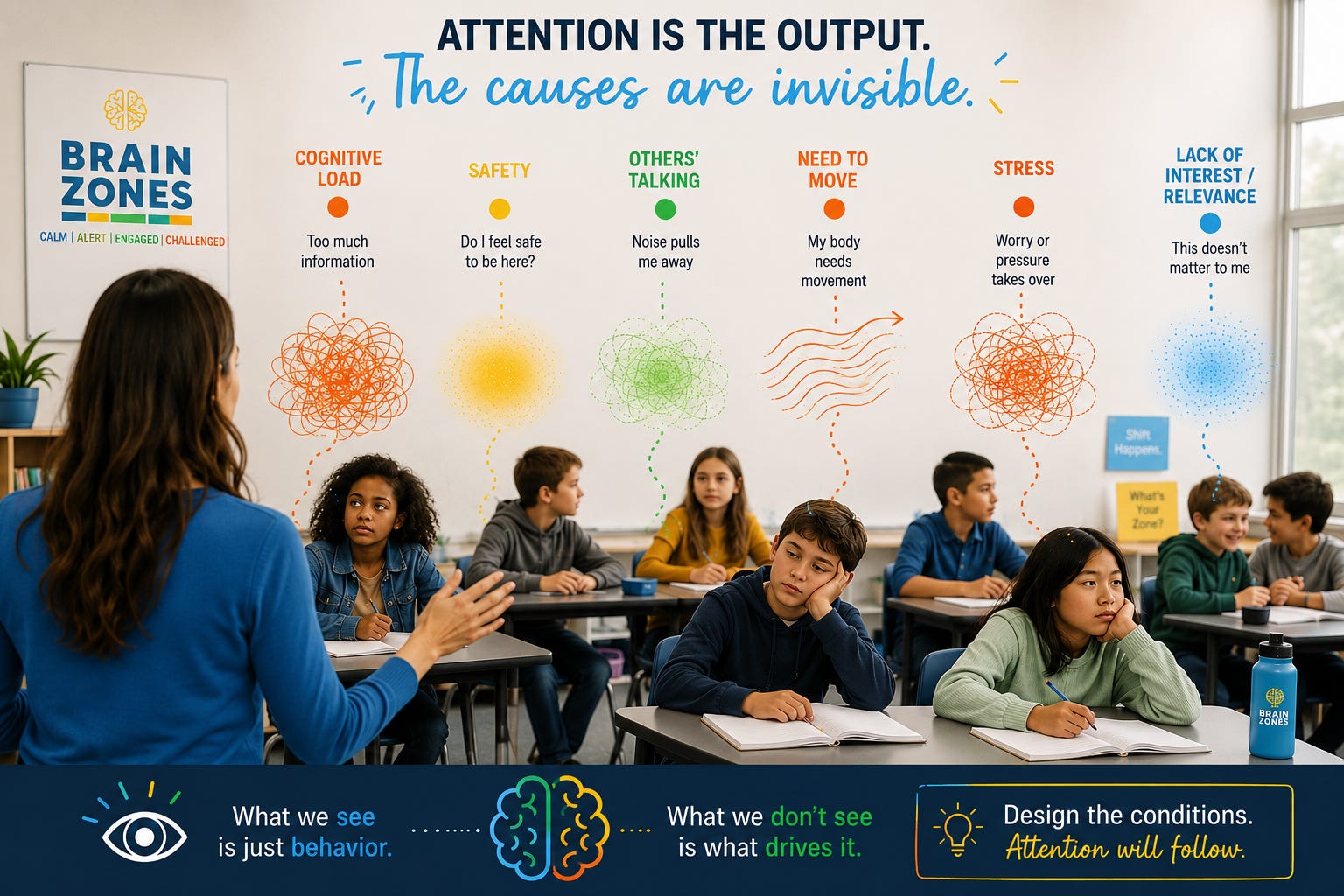
Every teacher knows the feeling of watching a room full of eyes slowly glaze over.
When a student drifts off, doodles, or starts whispering to their neighbor, our instinct is to target the behavior. “Eyes on me.” “Please focus.” “I’ll wait.” We treat attention like a faucet the student can simply chose to turn on or off. Sure, our redirect may capture there attention for a second or two, but it most likely won’t last.
But what if attention isn’t a fixed resource or a behavioral choice at all? What if attention is just the visible check-engine light for whatever is actually going on inside a student, how safe they feel, how much cognitive load they are carrying, how much the material means to them right now?
If we want to fix the attention crisis in our classrooms, we have to stop targeting inattention and start designing for what is actually driving it.
If a student is staring off in space, we have no way of knowing if under the hood they are collecting and connecting new ideas. Or, if their mind is wandering with no mission at all.
When the conditions in the room are right, attention stops being a fight. When they are wrong, no amount of behavior management saves the lesson.
Debunking the age-minute myth
For years, professional development has repeated some version of the same claim. A child’s attention span in minutes matches their age. A ten-year-old gives you ten minutes. A fifteen-year-old gives you fifteen.
It sounds tidy. It is not true. There is no fixed rule linking a child’s age to a set block of attention.
What the research actually shows is that attention is dynamic and rhythmic. It does not drain steadily from full to empty over forty five minutes like a battery running down. Students do not walk in, shift into one gear, and stay there the whole period. Their brains ride waves shaped by emotion, motivation, cognitive load, and whatever else is competing for their attention that hour.
What is actually driving it under the hood
Attention emerges from the interaction between the learner and the learning environment. Sleep, stress, prior knowledge, emotions, relationships, classroom climate, instructional design, and the task itself all play a role.
Teachers cannot influence all of those factors, but they can intentionally shape many of the conditions students experience once they walk through the classroom door.
Safety and trust. Is this a room where it feels safe to be wrong?
Perceived competence. Does the student believe they can succeed, or does the task feel out of reach?
Interest and relevance. Does the brain have a reason to care about this material or about doing well?
Outside stimuli. What else is competing for the student’s attention before you even begin?
Their mental state at the start. Did you intentionally help students settle, focus, and transition into learning before asking them to think deeply?
Look at that list and ask a different question. Instead of asking, Why aren’t they paying attention? ask, Which of these conditions can I influence? You cannot control what happened on the bus that morning or what a student walked in carrying. You can shape what happens in your room over the next forty five minutes. And those conditions often make the difference between students who merely show up and students who truly engage.
Plan With Shifts Mind
Stop watching for the moment a student drifts. By the time you see it, the shift has already happened.
Attention fluctuation is inevitable. It is neurological. The brain is not designed to stay in one mode for forty five minutes straight. Whether that mode is nonstop lecture or nonstop group work, no single instructional mode reliably sustains attention for an entire class period. The shift happens underneath the surface, and most of the time we cannot know exactly what triggered it. It rarely shows up as visible behavior at all. Scanning faces for signs of disengagement means relying on a delayed and imperfect signal of something happening inside the brain.
So do not wait to catch it and react. Waiting is already too late. Build opportunities for attention to shift before it drifts instead. Treat the lesson as a moving sequence: direct instruction, a quick partner check-in, independent work, a brief reset, rather than one static block that runs straight through the period.
Design it that way from the start, and attention stops being something you have to catch in the act. It becomes something you have already planned for.
When you plan your next lesson, don’t ask, How will I keep students paying attention? Ask, Where will attention naturally need to shift? Then design for that moment before it arrives.
What did you notice in your classroom this week that connects to this? Reply and tell me.
Remember, Shift Happens.
Debbie
For those who like the research
Cognitive Load, Affect, and Regulatory Strategies: A More Integrated Model (Frontiers in Psychology)
This study shows that a student’s emotional state directly dictates their working memory and processing capacity. When stress, boredom, or self doubt spikes, the brain is too overloaded to allocate the cognitive resources needed for attention.
A Rhythmic Theory of Attention (Trends in Cognitive Sciences)
This study reveals that human attention is not a continuous spotlight, but a rhythmic cycle that naturally alternates between focus and scanning. It proves that the “flip on, flip off” pattern is a hardwired neurological feature rather than a behavioral failure.
Attention Matters: How Orchestrating Attention May Relate to Classroom Learning (CBE: Life Sciences Education)
This research demonstrates how active learning succeeds by intentionally guiding students through shifts between listening and mental processing. It supports the idea that student focus is an outcome of a carefully designed instructional flow.