


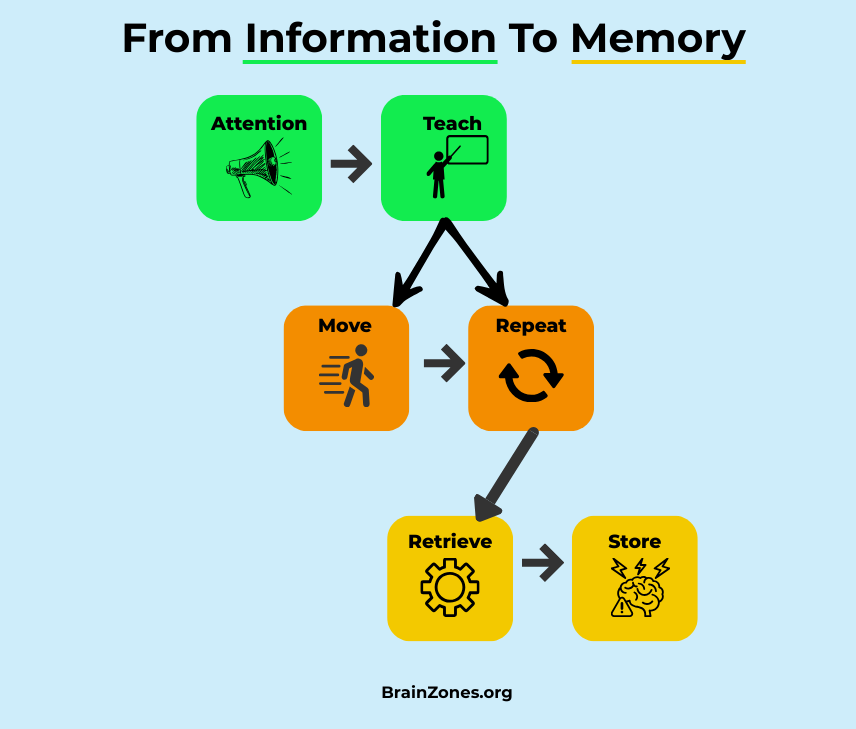
1. Attention (Focused Engagement)
The Science Word: Selective Attention
The Classroom Rule: “If the brain doesn’t notice it, it can’t learn it.”
The Idea: Learning begins the moment students tune in. Attention acts as the brain’s gatekeeper. Nothing gets encoded until the brain decides it matters. A brief hook, a clear cue, or a visual signal snaps the brain into readiness, opening the door for new learning to take hold.
2. Teach It (Initial Encoding)
The Science Word: Encoding
The Classroom Rule: “Make the idea simple and sticky.”
The Idea: This is the teacher’s moment to deliver the core meaning, keep it short, clear, and concrete. Students need just enough information to build an anchor in long-term memory. A clean explanation, one strong example, or a short demonstration sets the stage for the brain to begin organizing what comes next.
3. Move It (Kinesthetic Encoding)
The Science Word: Embodied Cognition
The Classroom Rule: “Move your body!”
The Idea: Pairing a fact with a physical action gives the brain two pathways to store the idea: verbal and motor. Movement boosts attention, increases blood flow, and creates an additional retrieval cue. It’s a built-in “backup key” for memory when words alone aren’t enough.
4. Say It (High-Ratio Active Response)
The Science Word: Active Recall Repetition
The Classroom Rule: “ALL brains go!”
The Idea: When every student says the answer at the same time, you create a fast, high-energy wave of engagement. Choral call-outs rehearse the idea out loud, strengthening neural connections. The more frequently students speak the idea, the easier it becomes for the brain to find it later.
5. Retrieve It (Retrieval Practice)
The Science Word: Retrieval Practice
The Classroom Rule: “Pull it out to lock it in.”
The Idea: Learning doesn’t happen by putting information in… it happens by pulling information out. Each retrieval strengthens the memory trace. A quick cold-call, a 5-second check, or a fast pair-share forces the brain to recall the idea, reinforcing the neural pathway and making the memory more durable.
6. Store It (Memory Consolidation)
The Science Word: Consolidation
The Classroom Rule: “Make it last.”
The Idea: After retrieval, the brain stabilizes and saves the information. This is how learning becomes long-term memory. When attention, movement, repetition, and retrieval all work together, the brain marks the information as “important” and keeps it accessible for future use.
See It In Practice
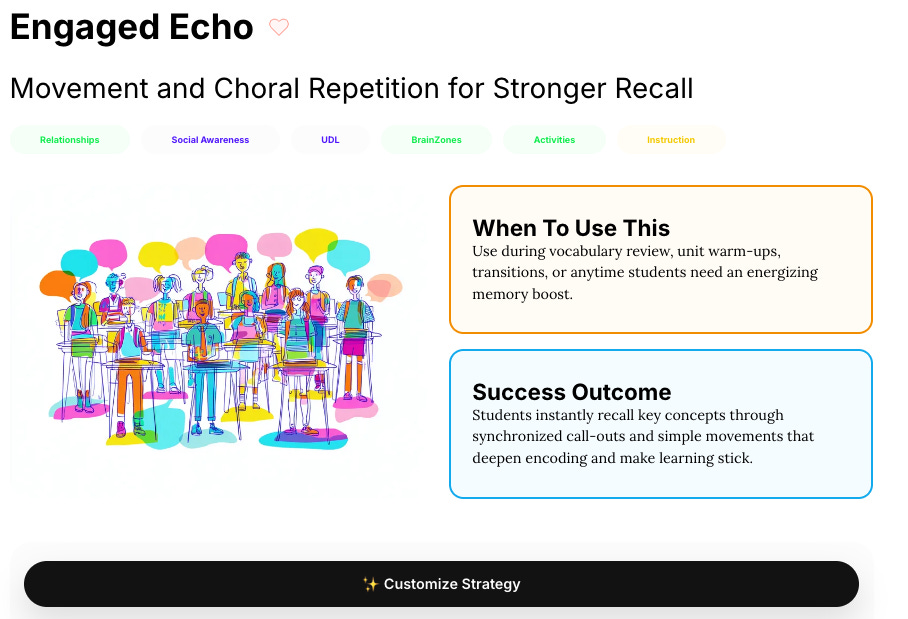
Engaged Echo is a quick call-and-response routine that pairs movement with choral repetition to strengthen memory, attention, and energy. All ages love this strategy.
✅ FUN ✅ EFFECTIVE ✅ ENGAGING ✅MAKES LEARNING STICK
📋 How To:
🎤 Teacher Call
Give a short, punchy prompt tied to essential content.
Students know a response is coming, which sharpens attention.
📣 Student Echo
Students choral-respond with the correct phrase.
The shared response builds accuracy and reinforces retrieval.
💥 Add the Movement
Pair the response with one small, repeatable gesture.
Movement adds novelty and strengthens the memory trace.
🔁 Repeat & Rotate
Run 3–5 quick rounds using the same structure with new prompts.
Keep the rhythm tight to sustain energy and focus.
🤔 Retrieval
Students return to their seats. The teacher says, “Circumference” The students write, “the distance around.”
Examples
Repeat each 3 or 4 times
1. Social Studies Law of Demand
Teacher says: “Demand is high”
Student Response: “Prices go up”
T - Demand is high; S - Prices go up
Movement: Students jump up slightly on “up” and clap once.
2. Science Vocabulary
Teacher Says: Photosynthesis
Student Response: Sunlight and water
Movement: Students open arms wide on “sunlight” and make a pouring motion on “water.”
3. Literary Element
Teacher Says: Alliteration!
Student Responses: It sounds the same!
Movement: Students make a quick waving motion with their hand to show repetition.
5. Math Rule
Teacher Says: Circumference
Student Response: Distance around
Movement: Students walk/jog in a circle around their desk.
For 100’s of forever free strategies go to brainzones.org
Click on “Brouse library 🆓.”