



Looking back, it is not surprising that I used to dread morphology. When prefixes, roots, and suffixes are taught only as definitions to memorize, students rarely see how those parts actually work together to create meaning.
Yet morphology is one of the most powerful tools available to readers for navigating difficult text. When students understand how words are built, they gain a way to unlock unfamiliar vocabulary across every subject area. Word parts become a gateway into the larger world of words.
Students need opportunities to work with language, not just memorize it. One way to provide that experience is an activity called Forge and Smash Words.
The Goal
Build word knowledge that expands vocabulary and improves reading comprehension by helping students understand how prefixes, roots, and suffixes work together to create meaning.
Activity Directions
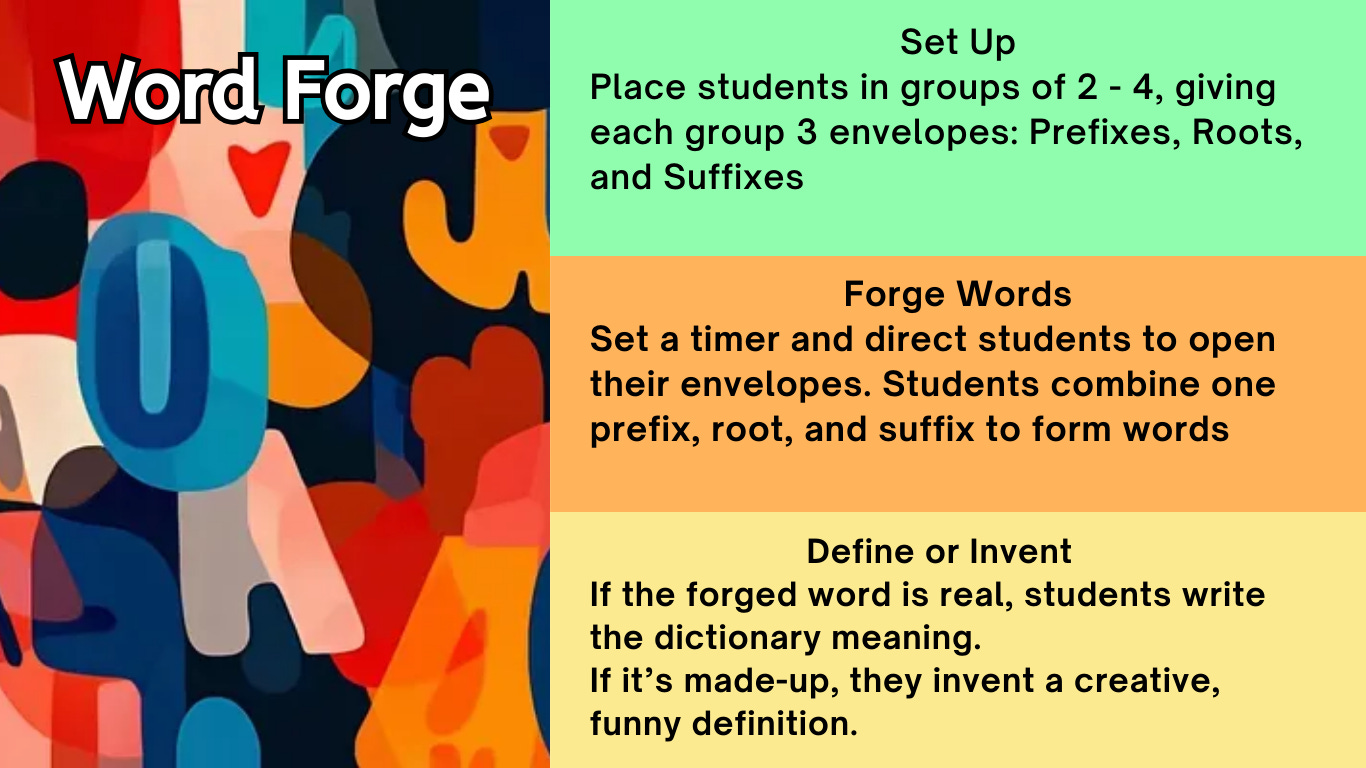
Details
1. Prepare the Word Parts
Have students create small cards for prefixes, roots, and suffixes and place them in labeled envelopes.
Example
Prefixes
re, un, pre, mis, dis
Roots
struct, form, port, spect
Suffixes
ion, er, ment, able
Create small groups and direct them to use one envelope of prefixes, one of roots, and one of suffixes.
Students spread the cards on their desks so they can clearly see the available word parts.
2. Forge and Define Words
Set a short timer to build energy.
Students combine one prefix, one root, and one suffix to create real or made up words.
Example
re + form + er → reformer
un + spect + er → unspector
Groups create three to five words and record them.
For each word, students decide whether it is real or invented.
If the word is real, they write the dictionary meaning.
If it is invented, they create a definition that logically matches the word parts.
Example
unspector
A person who refuses to watch scary movies.
3. Smash Words (Optional)
Groups exchange word lists with another group.
The new group decides whether each word is real or invented and explains their reasoning using the word parts.
5. Explain to Score
The original group reveals the answers.
Groups earn a point for each correct judgment when they can explain the word using the prefix, root, and suffix.
Finish by voting on the most creative invented word.
As literacy researcher Lyn Stone explains,
“Knowing how words work, having an understanding of a core of prefixes, roots, and suffixes, helps children generate the meaning of new words.”
Many academic words share common roots and affixes. When students understand a root such as struct, meaning to build, they can interpret related words including structure, construct, instruct, and reconstruction.
Instead of learning vocabulary one word at a time, students begin recognizing patterns within language.
Why This Activity Works
Forge and Smash Words asks students to:
Analyze word structure
Test whether combinations make sense
Explain how word parts shape meaning
Through this process, students move from recognizing word parts to using them as tools for understanding words and improving comprehension.
The activity also introduces creativity and light competition, helping maintain engagement while students practice a skill that supports reading across subjects.
Ways to Extend the Activity
This activity can grow throughout the year.
Add new word parts as they appear in science, social studies, or literature.
For example:
Science roots
bio, thermo, geo
History roots
demo, chron
Students can also collect interesting word parts from their reading and add them to the envelopes. Over time the envelopes become a growing bank of word knowledge.
Understanding word parts helps students make sense of complex language. As Carl Hendrick notes,
“You cannot summarize a passage if you do not understand the semantic relationships between its sentences.”
Helping students understand how words work is one of the most powerful ways to strengthen comprehension.
Thanks for being here,
Debbie
Feedback is welcome. If you know of any colleagues looking for proven practices and activities, please share.