


Behavior Is Not One System
If we want behavior to improve, we have to pinpoint what’s not working.
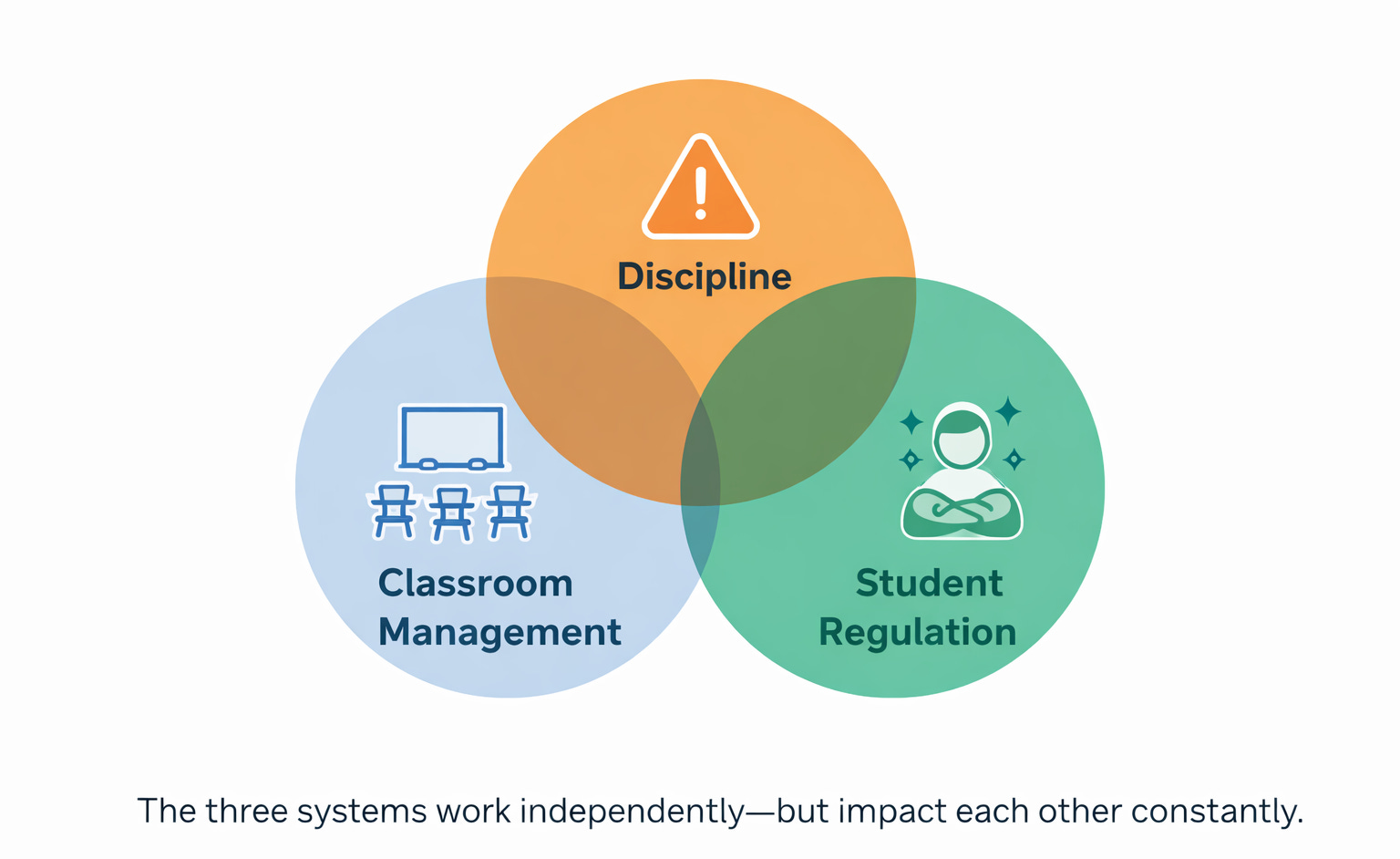
There are three facets to behavior, each playing a different role.
1: Classroom Management
The structure of the room.
Routines, expectations, and transitions.
Lesson design that keeps students engaged and focused.
2: Discipline
How behavior is shaped over time.
What is reinforced, corrected, and followed through on.
Consistency, flexibility, and accountability.
3: Student Regulation
In the moment self control and awareness.
Recognizing escalation.
Bringing themselves back.
Where It Starts to Fall Apart
These three facets of teaching are often lumped together, making it difficult to see the source of the problem.
When you think of them as separate, yet designed to work together, it becomes easier to identify the actual problem.
Problems can begin because rules and routines are not firmly established.
Or, they can present themselves when learning demands are too difficult or not challenging enough.
Or when instruction becomes stagnant, lacking variety, interaction, or changes in energy.
Our discipline systems are often expected to address problems that begin with routines or lesson design.
We primarily rely on redirection and negative consequences to correct behavior, even though research consistently shows that behavior improves when it is intentionally built through positive reinforcement.
Most of us have established routines, well planned lessons, and a set of consequences when behavior breaks down.
However, behavior challenges shift the teacher’s attention.
Focus moves from instruction to interruption.
The flow of the lesson breaks.
Momentum is lost.
And the room can quickly feel less predictable, and at times, less safe.
What was planned gives way to what feels necessary in the moment, and the priority shifts from learning to control.
In that moment, another element comes into play.
The student’s ability to manage themselves when emotions are elevated.
And for many students, that is not a skill they have fully developed yet.
Identify Patterns
Before trying to fix behavior, step back and look for patterns.
Is it a few students, or is it many?
Is it happening in every class, or only one or two?
Does it happen daily, or only occasionally?
What does the behavior look like?
Is it overt defiance or aggressive behavior?
Or are students off task and causing disruptions?
If the behavior threatens safety, your response should be calm, immediate, and non-threatening.
If it is a few students, the issue may be individual.
If it disrupts the whole class and interrupts instructional time, address it as a class.
Of course, professional “in the moment” judgments take priority.
Ask Yourself
Are my routines and expectations the issue?
Is the problem occurring during transitions, or unstructured moments?
Are students clear on what they should be doing?
Do students have the materials to complete the task?
Did I model, practice, and reinforce this routine enough?
Is my instruction the issue?
Is the problem occurring during the lesson itself?
Are students losing focus, rushing, or shutting down during the task?
Is the pace too fast or too slow?
Is the work too difficult or not challenging enough?
Are directions clear?
Is my discipline approach the issue?
Have I modeled what I want to see and hear, and what I don’t want to see and hear?
Am I using specific positive praise more than correction to reinforce the behaviors I want to see?
Am I reinforcing the majority to influence the few?
Is this a self-regulation issue?
Have I taught students strategies to calm the mind and body?
Do I practice these with them regularly?
Do I model self-regulation when I am frustrated or overwhelmed?
Do I co-regulate to help students settle and refocus?
Have I taught strategies like visualization and body awareness?
When behavior breaks down, it is not random.
It is a signal.
When we take the time to identify the cause, we can respond in ways that change it.
If this was helpful, consider liking or restacking so it can reach more classrooms.
Debbie Leonard
Co-founder, BrainZones
Helping teachers design lessons that improve attention, engagement, and behavior