

Recognize, Before You Respond.
Have you ever heard yourself short tempered or inpatient?
Snapping at students, “Put your hands down and get to work.”
Most teachers have.
The surprising part is that moment usually did not begin with that situation.
It began sometime earlier.
The Morning We Never Notice
Every teacher is trained to notice what is happening around them.
You notice the student who looks confused before they raise a hand. You notice the one who seems anxious, the one who has not started working, the side conversations beginning in the back of the room, and the subtle shift in energy that tells you the class is becoming restless.
Good teaching depends on paying attention.
But there is one person teachers often fail to monitor.
Themselves.
Not because they do not care. Quite the opposite. Most teachers are so focused on meeting the needs of their students that they rarely stop to notice what is happening inside their own minds and bodies. By the time they do, the moment has already passed.
Consider Cindy, an experienced eighth grade English teacher.
Her day begins with a series of small frustrations. Two boys walk into class with their phones out. She reminds them, again, to put them away. A few minutes later she realizes nearly half the class has not completed the homework assignment. She feels disappointed, then irritated. As she walks the room collecting papers, her internal dialogue quietly changes.
This is ridiculous.
They do not seem to care.
Maybe they think there will not be any consequences.
She keeps teaching.
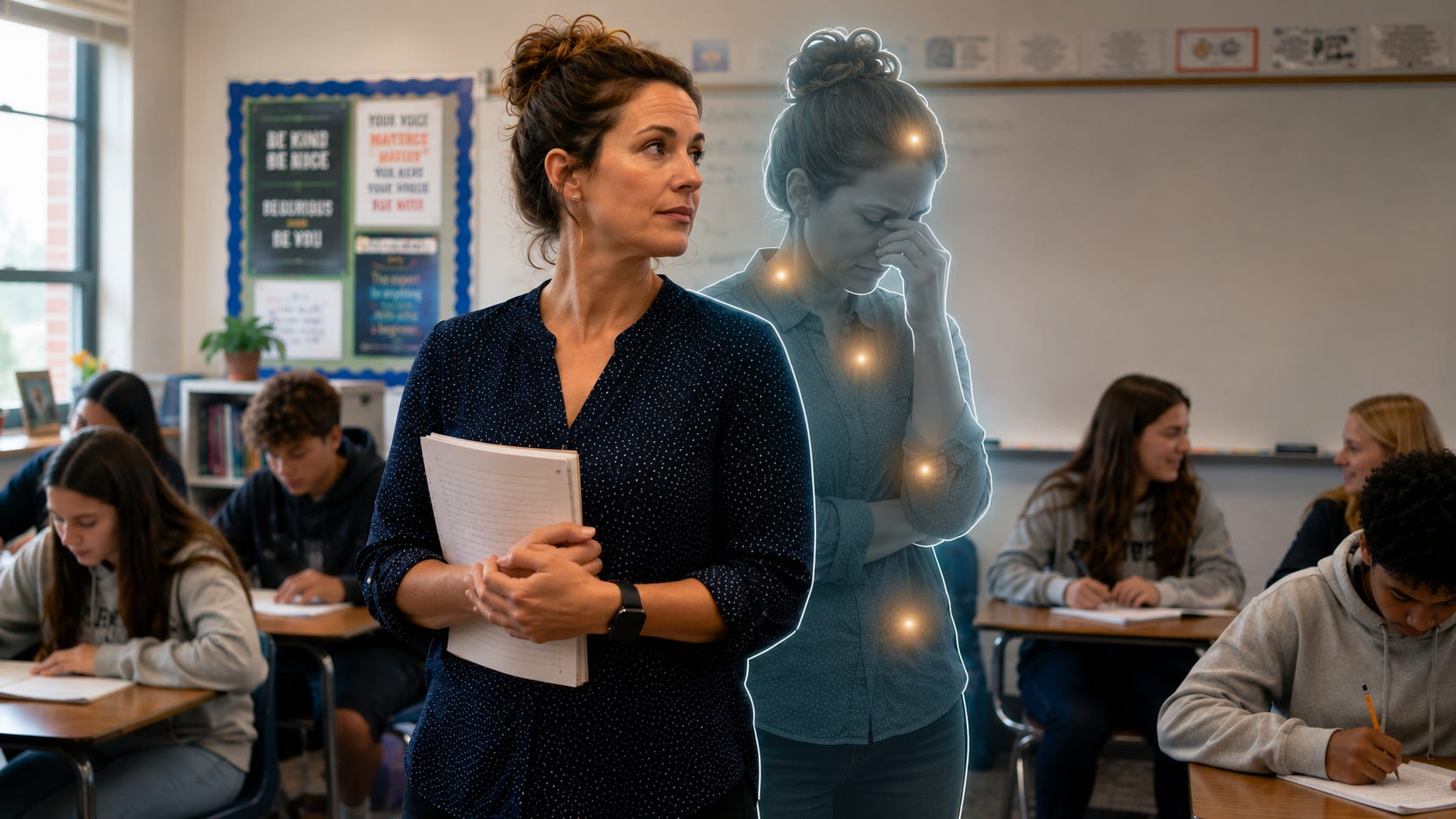
What Cindy does not notice is that her body is changing along with her thoughts. Her shoulders are tightening. Her jaw is clenched. Her breathing has become shallower. None of these changes seem important, so she ignores them and moves on.
Most of us would.
What Most Teachers Miss
Before our words change, our bodies usually do.
Tight shoulders.
A clenched jaw.
Shallow breathing.
Racing thoughts.
We notice the student talking across the room long before we notice what is happening inside ourselves.
The Moment Everything Changes
The lesson begins. Students are reviewing yesterday’s learning when Cindy notices Marcus and Thomas talking in the back of the room. She calmly asks them to stop. They do.
Three minutes later, they are talking again.
Pause for a moment.
Most teachers know exactly what happens next, not because they have seen it happen, but because they have felt it happen.
Your shoulders rise.
Your jaw tightens.
Your breathing moves higher into your chest.
A small voice says, I am getting irritated.
Then another voice answers, I do not have time for this.
So you keep going.
That decision, the choice to ignore what your mind and body are trying to tell you, is often where the real problem begins.
Cindy responds with words she had not planned to say.
“Do you want to tell the whole class what is so important?”
The room becomes silent.
She assigns an additional written punishment. Then she tells the boys to stand for the remainder of class.
The consequence was directed at two students.
The emotional climate changed for everyone.
The conversation was not the cause.
It was simply the last straw.
What Your Brain Is Trying to Tell You
Looking back, the conversation in the back of the room was not really the cause of Cindy’s reaction. It simply revealed what had been building all morning.
This is why the first step in RUMA is Recognize.
Recognition is more than identifying an emotion after it has taken over. It is learning to notice the small changes that happen before your emotions begin making decisions for you.
Our brains are constantly gathering information from both the outside world and from inside our own bodies. We readily notice what is happening around us because that is where our attention naturally goes. What we often overlook are the quieter internal signals. A tightening jaw. Shallow breathing. Racing thoughts. Growing impatience. A subtle shift from curiosity to judgment.
These signals matter.
As stress gradually builds, the brain has a harder time supporting the thoughtful, flexible thinking that helps us stay patient, solve problems, and respond intentionally. Emotional and threat sensitive systems begin to exert more influence, making our reactions quicker and often stronger than the situation actually requires.
The remarkable thing is that our bodies usually know this is happening before our minds catch up.
The problem is not that the signals are absent.
The problem is that we often decide they are not important enough to deserve our attention.
Recognition Is More Than Awareness
Most teachers notice they are becoming frustrated.
Recognition happens when you decide that feeling deserves your attention.
Recognize Before You React
Teachers do this every day.
“I am fine.”
“I will deal with it later.”
“I just need to get through this lesson.”
Meanwhile, the tension continues to build.
Recognition interrupts that cycle.
It does not require a five minute mindfulness exercise or leaving the classroom. Sometimes it takes only a few seconds to ask yourself:
What am I noticing right now?
Maybe your shoulders are tight.
Maybe your breathing has become shallow.
Maybe your thoughts have become increasingly negative.
Simply noticing those changes creates a small but important space between what you are feeling and how you will respond.
Recognition is not only about catching yourself when you are becoming frustrated.
It is also about noticing when you are calm.
Think about the moments when your lesson is flowing, students are engaged, and you feel relaxed but alert. Your breathing is easier. Your thinking is flexible. Your patience seems effortless.
Those moments deserve your attention too.
Because you cannot intentionally return to a state you never learned to recognize.
The goal is not to eliminate frustration. Teaching is too complex for that.
The goal is to become aware of your internal state early enough that you still have choices.
Every classroom has difficult moments.
Every teacher experiences stress.
The teachers who navigate those moments most effectively are not necessarily the ones with fewer challenges.
They are the ones who notice themselves before their emotions begin running the lesson.
You cannot regulate what you do not recognize.
Cindy’s words to Marcus and Thomas were not planned. They came out harsher than she intended, because the moment that produced them started long before the two boys ever spoke.
It happens to all of us, unless we recognize and take action to minimize.
Remember, Shift Happens,
Debbie
Thank you so much for this article. I truly enjoyed how well you explained the dynamics of being a classroom teacher. I have been in the classroom for 30 years and you described it perfectly. This is a really important article for newer educators to read and I hope it gets to them. I have always reminded myself not to feel antagonized by a 12 year old:)) that helps to in order to put it in perspective.